Lights, Camera, Carbon: Unveiling the Energy Footprint of AI Video Generation
In this blog, we introduce our new paper, give you the context on the research behind it, explain why this matters, and present what’s next.
July 7, 2026 — By Nidhal Jegham and Sasha Luccioni
Generating videos with AI models has become easily accessible to millions of users across the world. With the click of a button (and enough imagination!), an entire cinematic universe can appear. But this comes with a cost in terms of dollars, energy, and environmental impact, which is yet to be meaningfully understood.
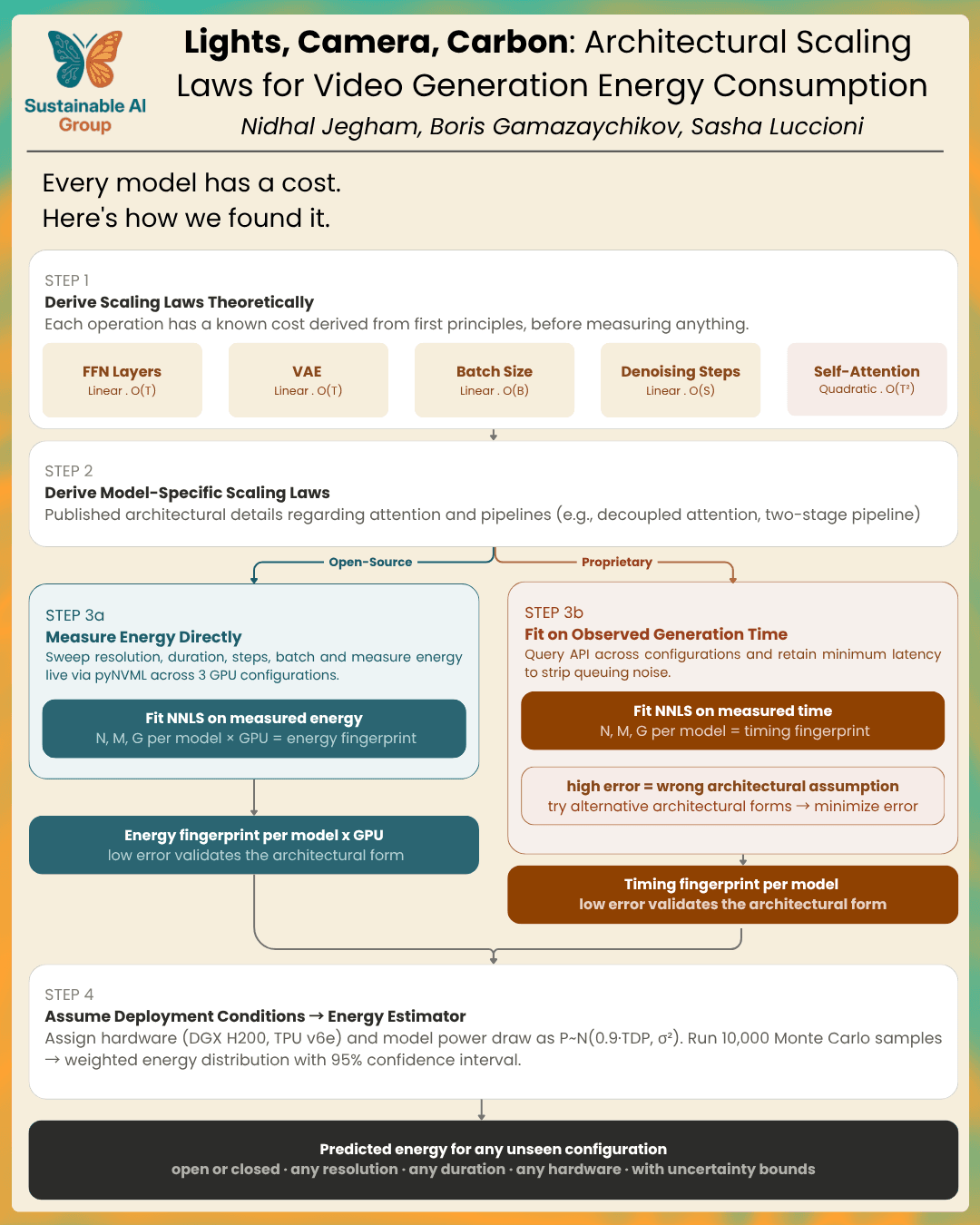
In Lights, Camera, Carbon: Architectural Scaling Laws for Video Generation Energy Consumption, which is currently undergoing peer review, we pulled back the curtain on the energy demands of text-to-video models and the factors that influence them. By building a first-of-its-kind bidirectional framework approach, we can now estimate how much energy these models consume forward, based on simple input parameters like resolution and duration – without ever needing access to secret, proprietary code or model weights. We can also estimate energy consumption backwards, treating accuracy as a criterion of architectural validity.
If a picture is worth a thousand words, how about a video?
Previous research by Sasha and colleagues has shown that image generation uses thousands of times more energy than text generation. But video generation models are even more energy-intensive. Because they iteratively denoise hundreds of frames across both space and time simultaneously, their energy demands explode. In Lights, Camera, Carbon, we found that running a standard 5-second video workload on common models can consume between 57.5 Wh and 114.8 Wh, which is like running a typical kitchen air fryer for up to 5 minutes!
Unlike text generation, video generation models are compute-bound – instead of working step-by-step, the GPU processes massive chunks of data across hundreds of video frames all at once, which forces the GPU to run at maximum thermal power. This means that the GPU power draw remains near the maximum, independent of parameter count or model size. Also, under fixed hardware, generation time is proportional to the number of calculations performed, which is itself a deterministic function of generation parameters.
Based on these observations and a series of empirical experiments on open-source models spanning 8.3B to 27B parameters, we were able to create a framework for predicting energy consumption based on the generation time and settings like resolution, frame count, and number of denoising steps.
3 things we learned about diffusion-based AI video generation
1. Bigger ≠ Hungrier
It’s tempting to assume that a bigger model burns more energy – more parameters, more math, more watts. However, our results say otherwise. HunyuanVideo-1.5, with 8.3B parameters, consistently used more energy per video than the original HunyuanVideo, which had 13B parameters. Meanwhile, Wan 2.1 (14B) used about twice the energy of HunyuanVideo, despite the two having a comparable number of parameters. The takeaway is that video diffusion models cluster in a much narrower and smaller size range than LLMs. Within that compressed range, parameter count stops being a meaningful signal, and architecture (how attention, denoising, and decoding are structured) is what actually determines energy cost. This also means you can’t just look at a proprietary model’s rumored parameter count and guess its energy footprint; you need to understand what it’s actually doing computationally.
2. 8x GPUs = 8x faster = 8x energy + overhead
With LLMs, adding more GPUs is often a win on two fronts. More GPUs means you can batch more requests together, and batching improves efficiency, since the cost of loading weights into memory gets amortized across more tokens generated. Video generation breaks that pattern entirely. Throwing more GPUs at it makes it finish faster, but it doesn't make it cheaper in energy terms, and it can actually make things worse. Because video diffusion models are compute-bound, doubling the number of GPUs roughly halves generation time while doubling total power draw, so the energy consumed stays about the same or even climbs due to communication overhead between GPUs.
3. Batching is a free lunch elsewhere. Not here.
If you’ve used an LLM, you know that batching queries together is one of the easiest ways to save energy per response, since the GPU is doing more work per unit of overhead. Video generation doesn’t play by those rules. When we generated HunyuanVideo outputs at batch sizes of 1, 2, and 4, the energy cost per video barely moved, with a difference under 3.3%. Because these models are already running their GPUs near maximum thermal power for a single video, there's no idle headroom left to fill with extra work. Total energy simply scales linearly with however many videos you generate at once. In other words, four videos cost four times the energy of one.

Peeking inside the black box
Because our framework proved that video diffusion models consistently max out hardware power consumption, we discovered we could reverse-engineer the energy profiles of closed, proprietary APIs by analyzing their generation latencies.
Through a series of API tests and statistical simulations, we mapped out the estimated energy footprint to generate a single 8-second 720p video across major commercial players: Google’s Veo 3, Seedance-1.0, Runway’s Gen-4.5, and OpenAI’s Sora 2.0 Pro.

Our framework sheds light on why OpenAI announced the discontinuation of Sora back in March – when scaled to high resolutions, our approach estimates that Sora 2.0 Pro demands a staggering 1,313 Wh per 12-second 1080p video! If it reached a deployment scale of 4 million users generating just two 720p clips a day, it would have consumed an estimated 602.6 GWh over six months – the equivalent to the electricity consumption of up to 142,000 average US households, during the same period, purely spent on generating short videos!

Accessing this data
Research performed by Sasha Luccioni, Boris Gamazaychikov and Nidhal Jegham, within the GenAI Footprint Alliance, piloted by Publicis and with AXA, Engie, Groupe La Poste/La Banque Postale (founding members) and also supported by FDJ United, Accor, L’Oréal, Orange, Renault Group (partner members) at the time of article acceptance. More companies may have joined since. Read more about the collaboration in our announcement.
The methodology behind these scaling laws has already been operationalized for enterprise use through integration with two open-source tools, and you can access it today through:
EcoLogits (CodeCarbon): a Python library that estimates energy consumption and environmental impacts of generative AI models called through APIs, accompanied by an online calculator.
e-footprint: a modeling toolkit, originally built by Publicis Sapient France and now open-sourced within Boavizta, for exhaustively estimating the environmental footprint of digital services.
Why this matters
AI video is transitioning rapidly from an online novelty into an enterprise tool used in everything from social media to advertising. As it continues to scale in usage, resolution, and length, the tech industry cannot afford to treat its environmental footprint as an afterthought. By grounding energy estimation in transparent, architectural first principles, we hope to provide the AI community with a standardized toolkit to benchmark, report, and ultimately design more sustainable systems for the planet.
What’s next
This video generation methodology builds directly on our ongoing text-generation work, which we are actively refining as frontier models and inference stacks keep evolving. Video was the next natural step, and it didn’t play by the same rules with different hardware bottlenecks, different architectures, and different mechanisms that can drive energy consumption up or down, and we don’t expect audio and image to play by them either. So the approach stays the same as we continue to tackle more modalities: derive the theory first, then put it in front of real hardware until the numbers align. Stay tuned as we continue pushing the envelope of AI’s environmental transparency.